
Identity Based Workplace Change
How we communicate 'the change' can positively influence the change

Highlights
Our organisational and individual identities can influence habits and vice versa
Both identities and habits can be used to positively influence change
Incorporate identities into key messages and incorporate new habits (ways of working) into current habits to drive change and make them stick
I was sitting in a meeting some time ago and the discussion was getting quite heated around why elements of a change that had been implemented weren’t going as successfully as planned.
The main conclusion that most people came up with, was that the ‘why’ wasn’t clear enough for the key stakeholders and that the team should have done more to define the ‘why’ and make it relatable.
There are many ways to relay the why, such as articulating in a way that is relatable to specific individuals, AKA ‘What’s in it for me?’ (the WIIFM).
What’s identity got to do with it?
Organisational identity, is the high-level, shared perspective of an organisation’s purpose, values and culture.
Self-identity on the other hand, refers to the way individuals perceive and define themselves. It encompasses a broad range of characteristics and beliefs that individuals use to answer the question, "Who am I?" This can include their values, beliefs, personality traits, roles, and social identity, as well as how they see themselves in relation to the world.
When we look at the research on individual motivators, identity and habits are usually part of the conversation. When we want people to change their ways of working, they need motivation to do so. Therein lies the importance of identity.
“A strong motivation, anchored in self-identity, may instigate repeated action, which may then become a habit.” (Verplanken and Sui, 2019).
In simplest terms, if we want our stakeholders to take positive action throughout workplace change and to work in new ways, we need to ensure that the change is connected to the organisational identity, and communicate the change in a way that is also relatable to the individual identities of our key stakeholders.
The research also tells us that habits can inform identity, as well as the other way around (i.e. identity can inform habits). So if we are introducing a change to the ways of working, we can either lean on current habits to contribute to a new organisational or team identity, or rely on the current identity motivators to create the habits of working in new ways.
Putting this concept into practice
An scenario of using identity to motivate habits (which are actions towards the change): A team leader wants to use more digital solutions to support their manual tasks, but currently no one in the team proactively ideates ways to do this, at the same time, as a team they carry an identity that they are ‘high performing’.
Action: This ‘high performing’ identity can be used to encourage new habits. The leader could facilitate a brainstorming session on ways to remain or strengthen their high performing identity using digital solutions. If the team is already high-performing in other ways, a question could be posed to the team as to how effectively using more digital tools can contribute to high performance. This approach enables more ownership of the process, rather than the leader simply telling them why it strengthens high performance.
A scenario of using habits to motivate a new identity (which will progress towards the vision of the change): The same team have monthly continuous improvement sessions to identity what they can do differently. These sessions are current habits that the team has in place.
Action: This habit and session, can be used to then translate digital solutions into continuous improvement opportunities. Rather than create new workshops and sessions and outlets to determine digital ways to create efficiencies, this team can use current channels (the habit of meeting monthly) to achieve the new identity of a team that has enabled digital transformation.
Below is a helpful diagram from James Clear, that our identity is core to who we are, and we know from researchers (Verplanken and Sui, 2019), that the evidence tells us that the identity can influence processes and outcomes, as well as vice versa (outcomes can influence our identity). We also know from the research, that we can have multiple identities (Van Bavel & Packer, 2021). For example someone holds an identity associated to their position as an accountant, at the same time they are an avid cyclist and also hold an identity as a cyclist.
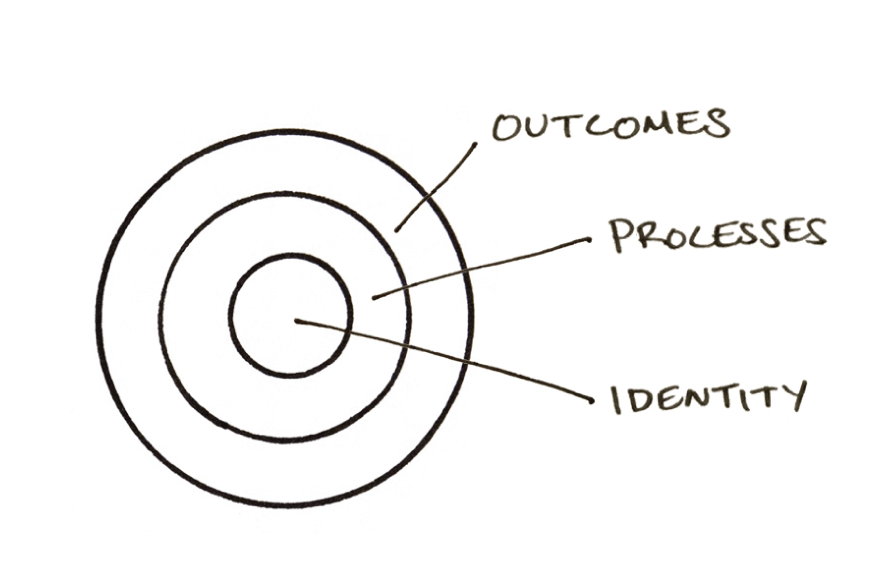
Here are some examples shared by James Clear, on building new individual habits, using identity, these can be helpful when you are designing your approach to writing key messages for your stakeholders:
Build new habits using identity, not outcome-based habits
The goal is not to read a book, but to become a reader.
The goal is not to run a marathon, but to become a runner.
The goal is not to be a certain weight, but to become a healthier person.
How can you relate the above to your organisation or team that is undergoing change?
Visit our website to learn more